
By Annika Spaet, ACE NY Fellow
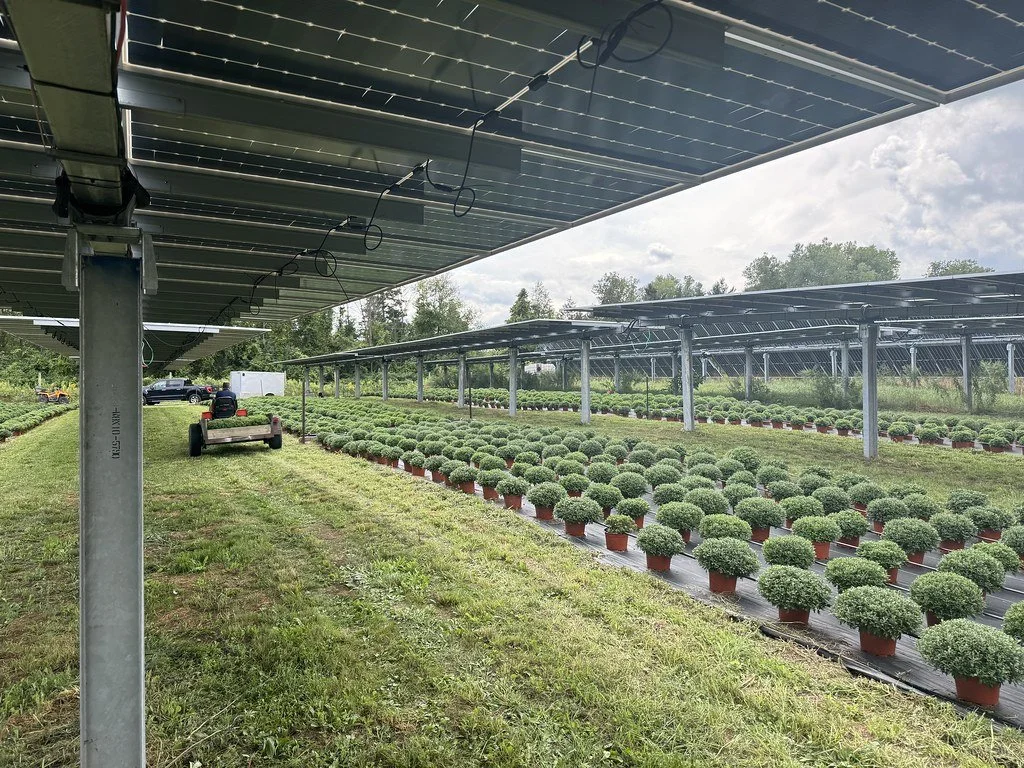
In the quaint Rochester suburb of Henrietta, NY, you can find the Remelt family farm run by Charlie, Sarah, Parker, and Allison Remelt. Among other crops, the Remelts grow flowering plants called chrysanthemums or ‘mums.’ While other farms raise these vibrant plants, the Remelts grow them a little differently: their collection of nearly 5,000 mums are grown under solar panels.
Their experiment reflects a growing trend across New York state. Farmers are increasingly looking for ways to adapt their farms as climate change and economic conditions threaten their livelihoods. By co-locating crops and solar panels on the same land – an approach called agrivoltaics – farmers can earn additional income while ensuring productivity on their land.
Despite the opportunity solar can offer to farmers, some are concerned that renewable energy development could threaten prime farmland. While large scale solar development has the potential to impact agriculture in some areas, the Remelts see agrivoltaics as a way to maximize solar development by growing crops concurrently with the production of electricity from solar power. Additionally, because mums grow no taller than three feet, the plants have proven to complement the panels well and have not interfered with electricity production.
Remelt Family Farm
After a number of years growing Christmas trees, a particularly labor-intensive crop, the Remelts began pursuing agrivoltaics as an alternative to maintain financial viability in a less physically strenuous manner. Since 2022, the Remelts have embraced this simultaneous use of land for agricultural production and energy generation.
The Town of Henrietta has supported this shift by issuing its Farmland Protection Plan, which specifically promotes agrivoltaics on small farms as a means to help maintain them as income-generating agricultural centers. The solar panels have been excellent at shading the mums, helping the Remelts to conserve water and reduce waste — especially as the only form of irrigation mums need is drip irrigation. Moreover, the shade has been helpful for Charlie and Parker to avoid direct sunlight when harvesting the mums.
Parker has voiced his continued support for agrivoltaics, “the ability for solar panels to work synergistically with farming operations in the local communities is a good opportunity to both grow and have benefit.”
The Remelt family farm is a clear case study showing that renewable development and agriculture can coexist. With intentional and deliberate mingling of the two areas, the model can achieve renewable energy goals while maintaining small farmers and empowering communities.
For the Remelts, mums are also only the beginning of the agrivoltaic story. They plan to explore other crops such as kale, broccoli, spinach, tomatoes, and peppers - these can also be great options for other farms. The Remelts’ success hints at a future where solar panels and crops can share the same fields, turning sunlight into both power and growth, and ensuring that sustainability and family farming can thrive together.
Hear more discussion about the Remelts’ farm from the 2025 ACE Fall Conference recorded here!